
Inside NSF-CPI wildlife monitoring at the San Diego Zoo Safari Park
By Sarah Lagattuta (Field Research Fellow)
As a Field Research Fellow with the NSF Center for Pandemic Insights, I recently spent two months at the San Diego Zoo Safari Park working on non-invasive wildlife disease monitoring. This deployment leveraged a unique opportunity to run cross-institutional projects in a rare setting where controlled conditions and real animal behavior exist side by side.
A major focus of my work was sampling volatile organic compounds (VOCs), chemical signatures captured from airborne compounds that can be found in bat breath. These VOCs can be associated with diseases like White Nose Syndrome, and potentially other viruses that naturally circulate within bat populations. Many of these viruses are a normal part of bat ecology and do not pose a risk to humans, but studying them helps us better understand how pathogens move through wildlife systems. Using a metabolomics air sampler developed by Dr. Cristina Davis’ lab at UC Davis, I collected VOC data from both wild bats roosting in bat boxes and captive Rodrigues flying foxes in the Safari Park’s Bat House.
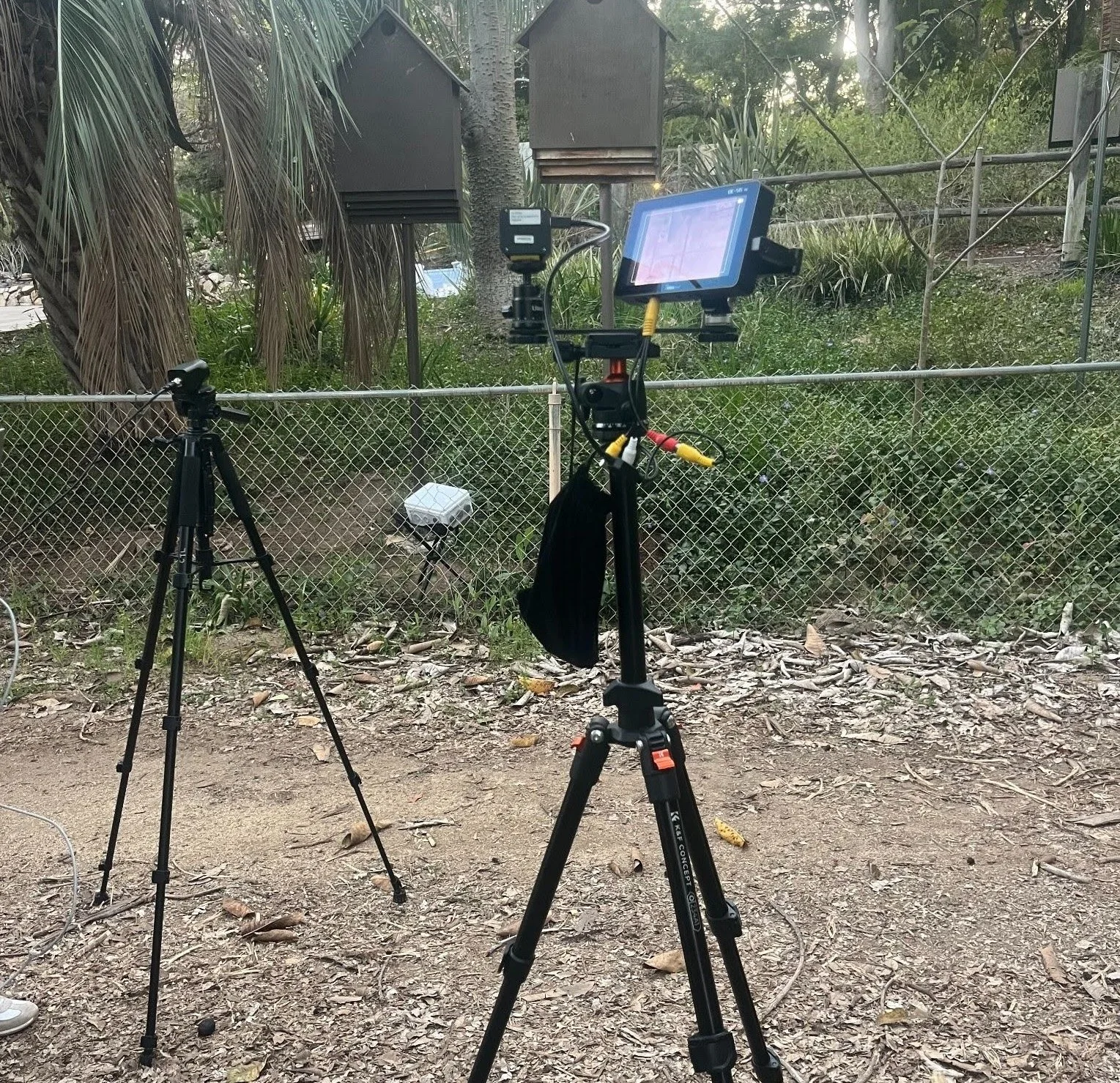
Thermal camera monitoring and “Everything” air sensor deployment for wild bat populations in bat boxes
The timing of this work was key for a central question we have with VOCs: Can the chemical signature of a roost tell us whether bats are present, and potentially how many there are?As native bats returned from winter torpor, I sampled bat boxes as they transitioned from completely empty to gradually occupied, capturing how the chemistry of a space changes as a population builds.
Alongside VOC sampling, I collected guano for downstream pathogen screening and thermal video of bat flight for population counting, helping connect environmental signals, viral shedding, and population changes. Together, these approaches contribute to developing non-invasive tools for tracking both bat colony occupancy and disease dynamics over time.
To complement this more targeted chemical sampling, I also deployed “Everything” air sensors developed by Dr. Pei Zhang’s lab at the University of Michigan. These sensors continuously track broader environmental changes, including CO₂ and particulate matter, providing context for how conditions surrounding animals may shift due to wildlife or human behaviors. In the future, these sensors could be used in diverse roost environments to non-invasively monitor bat behavior and seasonal activity.
As another key component of my deployment, I worked with Safari Park teams to conduct environmental sampling for avian influenza across habitats where native birds and managed collection birds share space. This included sampling water sources and other environmental substrates to better understand how shed viral RNA may persist in the environment over time.This work helps inform how avian influenza moves through shared habitats and how environmental reservoirs may contribute to transmission risk.
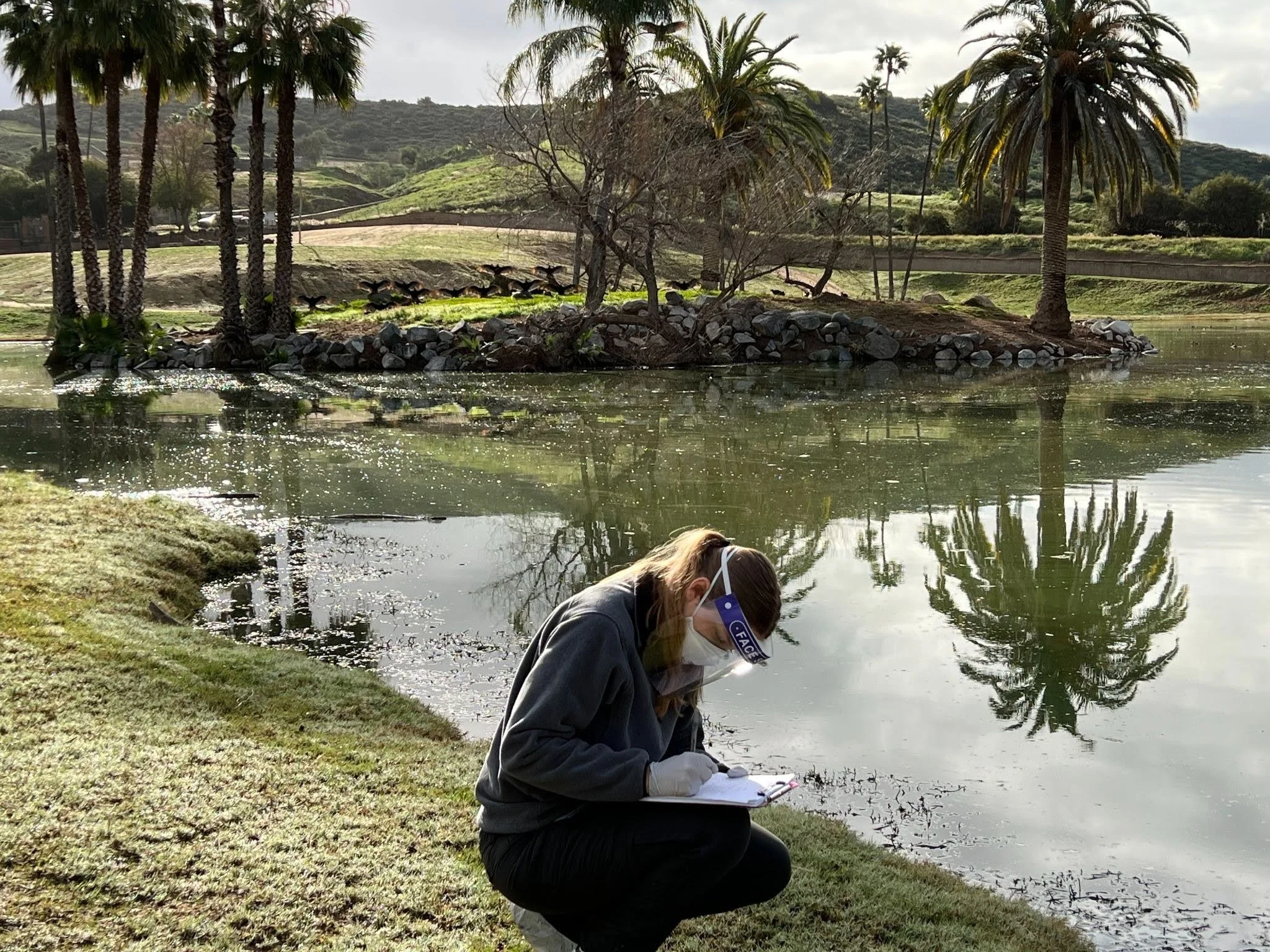
Environmental sample collection for monitoring avian influenza presence and persistence in habitats
This deployment was an incredible opportunity to implement emerging technology from institutions across CPI. I would like to extend a massive thank you to all of the groups involved, including the Conservation Technology Lab and Molecular Diagnostics Lab at the Safari Park, as well as the animal care specialists who made this work possible. It was a fast-paced and challenging two months, and I’m excited to see what these data reveal and how these approaches can scale to more complex wildlife systems.