
Announcing NSF-CPI’s 2025 Trainee Transdisciplinary Research Award Recipients
At the Center for Pandemic Insights Annual Meeting last year, CPI announced the 2025 Trainee Transdisciplinary Research Awards, a competitive funding opportunity supporting trainee-led projects that integrate new creative research ideas across at least three disciplines and are co-mentored outside the trainee’s primary area of expertise.
The two awarded projects reflect CPI’s emphasis on transdisciplinary collaboration across engineering, computer science, ecology, and disease-related research.
“Everything Sensor”: A Multimodal Sensing Platform for Environmental and Bioacoustic Monitoring
Student Researchers: Julia Gersey, Jiale Zhang, Jeongmin Chae
Mentors: Dr. Pei Zhang, Dr. Urbashi Mitra, Dr. Cristina Davis
This project proposes the development and deployment of the “Everything Sensor,” a sensing unit that can simultaneously measure environmental conditions, bioaerosol-relevant gas concentrations, and audio-visual signals through vibration, acoustic detection, and thermal imagery. This compact, multi-modal device will be used near bat roosts to examine whether spatial and temporal variation in air quality and acoustic or vibrational signatures correlates with bat activity, ecological stressors, and seasonal patterns such as migration and pupping.
BT3 : Bat Tracking with Thermal Tag
Student Researchers: Jiale Zhang, Julia Gersey, Caleb Huntington, Sarah Lagattuta
Mentors: Pei Zhang, Tigga Kingston, Simon Anthony, Christine Kreuder Johnson
While thermal imaging enables visualization of bat flight and roosting behavior in low-light environments, it generally lacks the resolution required for reliable species identification. This project leverages the high-contrast appearance of low-emissivity materials in thermal imagery to design passive thermal tags for species identification within multi-species bat colonies. By developing distinct tag shapes that can be detected in thermal video, the project aims to improve understanding of how different bat species co-occur within roosts and how these interactions may influence the potential for cross-species viral transmission.
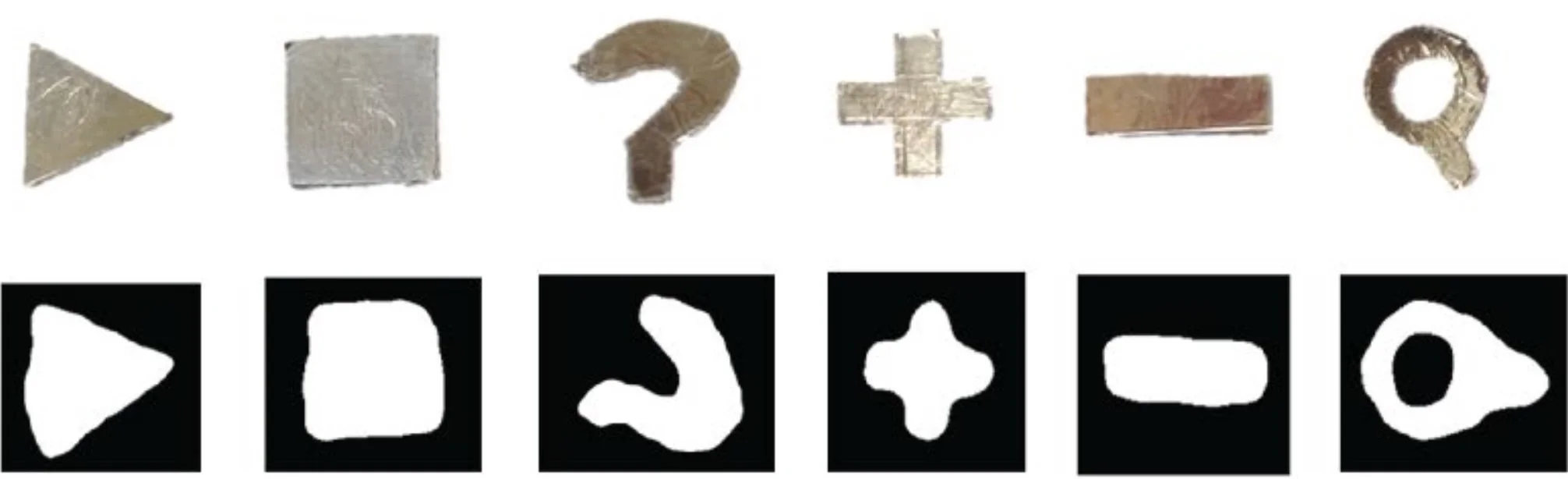
Thermal tag designs in visual spectrum footage (top) and thermal imagery (bottom)
Together, these projects demonstrate how transdisciplinary collaboration across the fields of engineering, ecology, virology, public health, and beyond can address technical challenges in wildlife monitoring using non-invasive approaches. We congratulate the awardees and their mentors and look forward to following the progress of these projects.